The AI knowledge base for global medical device regulations
42 public knowledge bases across 8 countries and regions, holding 1,588+ regulations, official guidelines and technical guidance — OCR-cleaned, table-repaired, and chunked by Article and Clause so every answer cites a passage you can check. Free to query with 500 signup points.11 min read
If you work in RA, looking up regulations across different countries and regions isn't a project. It's Tuesday. Does this apply in Brazil. What does the Korean equivalent of this clause say. Which MDCG guidance superseded the one I bookmarked.
Well-run teams handle this the obvious way: they collect the regulations and organize them into folders. Country, then regulation, then version. It looks tidy, and it is genuinely better than nothing.
It's also still painful to actually use.
You can only search it by hand. A folder of PDFs has no answer layer. You know the clause exists; you're opening documents and using Ctrl+F to find it, which works right up until the wording you remember isn't the wording that's printed.
And feeding those PDFs to an AI doesn't fix it — it often makes it worse. This is the part that surprises people. Raw regulatory PDFs are hostile input. They carry page headers and footers on every page, running footnotes, watermarks, line numbers, and page-break artifacts that split sentences in half. Tables — which in regulatory documents are frequently where the actual requirement lives — come out mangled: columns collapsed, header rows lost, cells shifted one position to the right so every value is attached to the wrong label. Scanned documents are worse again.
Point an AI at that, and you get answers that are fluent, confident, and wrong. Not because the model is bad, but because it faithfully read a table where the "Class IIb" column had quietly become the "Class III" column. This is the failure mode nobody catches, because a wrong answer with a real-looking citation reads exactly like a right one.
And that's the well-organized case. For an individual consultant or a small team, maintaining a global regulatory database — multiple jurisdictions, each with its own revision cycle, each needing to be re-cleaned every time a document is reissued — is simply not realistic. The work has nothing to do with your actual expertise, and it never ends.
So we built the public global regulatory knowledge base. We do the collecting, the cleaning, and the re-indexing; you query it and get answers with the source passage attached. Sign in with a Microsoft account and 500 free points, and you can start asking it questions today — no plan required. Here's what's in it and how it was built.
What a Public Knowledge Base actually is
A knowledge base in RAQB is a collection of indexed content — files, notes, URLs, crawled website maps — that the AI searches before it answers you. Private ones you build yourself: you upload, we chunk and embed, and your chat and compliance reviews get grounded in your own documents.
A public knowledge base is the same machinery, with the maintenance burden moved to our side. Published by RAQB or by creators, read-only, available to everyone. You don't upload anything, you don't re-index when a document is revised, and you don't pay per document for storage you're not managing.
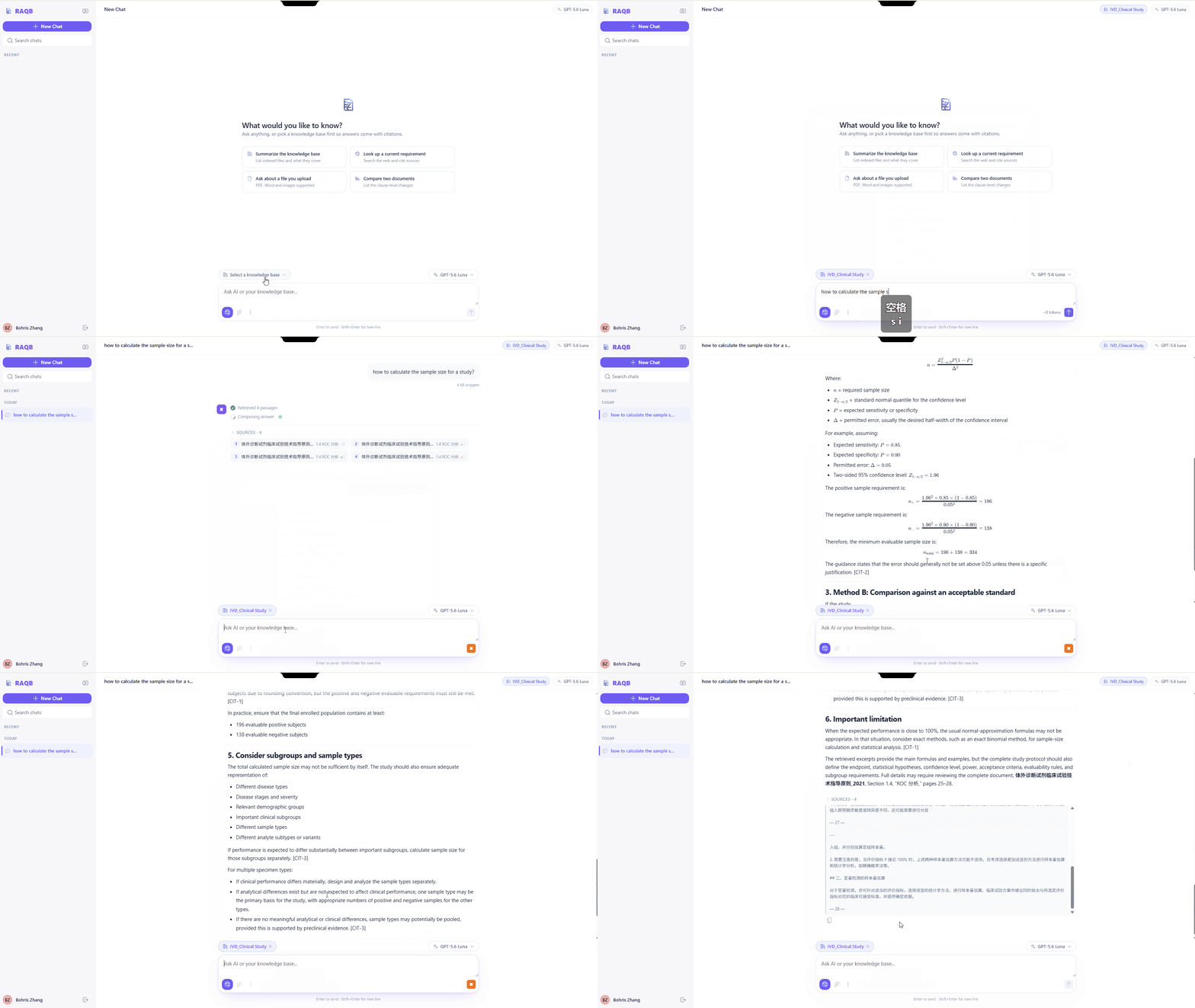
The practical difference shows up in a chat answer. Ask a question with a public KB selected, and the response comes back with a Sources section listing the specific passages it drew from. Not "according to the MDR" — the actual retrieved chunk, from the actual indexed document, so you can check whether the model read it the way you would have.
What's on the shelf today
42 public knowledge bases · 8 countries and regions · 1,588+ indexed regulations, official guidelines and technical guidance.
The split is deliberate — one knowledge base per regulatory topic rather than one giant "EU" bucket, so retrieval stays inside the right corpus instead of pulling a Brazilian post-market clause into a question about MDCG guidance. The number after each name is how many documents are indexed in it.
🇪🇺 European Union — 10 knowledge bases
- MDCG-Notified Body Related — 37+
- MDCG-UDI & EUDAMED — 31+
- MDCG-Clinical Evaluation — 26+
- EU_Classification_MD_IVD — 16+
- MDCG-Vigilance & PostMarket — 11+
- MDCG-Transitional Provision — 11+
- MDCG-Labeling & Instructions — 8+
- MDCG-Software and MDSW — 5+
- EU_IVDR — 2+
- EU_MDR — 1+
🇺🇸 United States — FDA — 10 knowledge bases
- FDA_Guidance-General Product Specs — 126+
- FDA_Guidance-Premarket Pathways — 121+
- FDA_Guidance-Postmarket Compliance and QMS — 76+
- FDA_Guidance-Radiation Specific Devices — 72+
- FDA_Guidance-Clinical Trials GCP — 63+
- FDA_Guidance-IVD Diagnostics — 44+
- FDA_Guidance-Fees Policies — 28+
- FDA_Classification_MD_IVD — 16+
- FDA_Guidance-Digital Health Software — 15+
- FDA 510(k) Pathway — 6+
🇨🇳 China — 5 knowledge bases
- China_Non-active MD Guidelines — 257+
- China_Active MD Guidelines — 244+
- China_IVD-Guidelines — 169+
- China_General Guidelines — 61+
- China_General_IVD — 5+
🇧🇷 Brazil — 3 · Brazil_General (16+) · Brazil_Pre-market_MD (6+) · Brazil_Pre-market_IVD (4+)
🇦🇷 Argentina — 2 · Argentina_Pre-Market (15+) · Argentina_Post-market (7+)
🇰🇷 Korea — 3 · Korea_General_MD (9+) · Korea_IVD (8+) · Korea_Digital MD (6+)
🇦🇺 Australia — 3 · Australia_Medical Device (5+) · Australia_General Framework (2+) · Australia_IVD (2+)
🇮🇳 India — 2 · India_Medical Device (3+) · India_IVD (1+)
🌐 Cross-jurisdiction — 4 · SaMD_Regulatory Hub (14+) · MDSAP (12+) · IVD_Clinical Study (6+) · RAQB User Guide (2+)
A few patterns worth noticing. Most jurisdictions are split pre-market / post-market or MD / IVD, because those are the axes an RA question actually falls along. The EU set separates the regulations themselves (EU_MDR, EU_IVDR) from MDCG guidance, and then splits MDCG by topic — transitional provisions and notified-body questions are different enough that mixing them costs retrieval precision. Software and digital health get their own knowledge bases in three jurisdictions, which reflects where the questions are actually coming from.
The document counts also show where the depth is. China's guideline sets and the FDA guidance library are the heaviest — several hundred documents each — while EU_MDR is a single consolidated regulation. A knowledge base with one document is not a thin knowledge base; it is one very long, very structured law.
This is not complete global coverage yet, and we're not going to claim it is — Japan, Canada, and the UK are the obvious gaps. But 42 is where we are this week, not where we're stopping: new jurisdictions are going live on a rolling basis, and we expect to pass 100 public knowledge bases before the end of the year.
So if your market isn't on the list above, it is worth checking again — the number in this article will be out of date, deliberately.
The Chinese-language UI shows localized names throughout (欧盟_MDR, 中国_指导原则-IVD), so the corpus is navigable in either language.
Why this beats uploading the PDF yourself
You can download the MDR and drop it into any AI tool today. Here is what happens at each stage when you do, and what we do instead.
1. Scanned documents
- Upload it yourself: an image-only PDF has no text layer. Most tools index it as empty or near-empty, and you get confident answers built on almost nothing — with no warning that the file never actually loaded.
- Ours: image-based and scanned files go through OCR before indexing. A lot of the older national regulations and translated documents only exist in this form.
2. Page furniture
- Upload it yourself: every page's header, footer, page number, watermark, and running footnote gets indexed as if it were regulatory text. It pollutes retrieval, and repeated boilerplate competes with the clause you were looking for.
- Ours: repeating headers and footers are detected across pages and stripped — with headings, list items, blockquotes, separators, and table rows explicitly exempted, so a short line that happens to be a real requirement doesn't get deleted along with the page numbers. Standalone markers like
5 / 12go;5|12stays, because that shape appears inside tables.
3. Tables — the one that actually costs you
- Upload it yourself: regulatory tables come out with collapsed columns, lost header rows, or every cell shifted one position. You don't notice, because the answer still reads fluently. It just describes Class III where the source said Class IIb.
- Ours: a dedicated pass reconstructs malformed tables — missing separator rows, misplaced separators, inconsistent column counts. Unglamorous, and it matters more than everything else here, because this failure mode produces a wrong answer that looks exactly like a right one.
4. Chunking
- Upload it yourself: generic tools split every N characters. That cuts clauses in half, so a retrieved fragment starts mid-sentence and the citation points at a boundary the regulation doesn't have.
- Ours: content is profiled —
legal_regulatory,medical_ifu, orgeneral— and split on the structure it's actually written in. Regulatory text splits on Article + Clause, the unit you cite. IFU-style content splits on sections and paragraph, list, or table blocks instead, because applying article-clause logic there would make retrieval worse. Detection is automatic, scored by confidence, and overridable.
5. Maintenance
- Upload it yourself: every reissue means re-downloading, re-uploading, and re-doing all of the above. Across a dozen jurisdictions on independent revision cycles, forever.
- Ours: we re-index. You don't do anything.
None of this is visible when it works. That is rather the point: the difference between a cleaned regulatory corpus and a folder of PDFs shows up in exactly one place — whether the answer you get is correct.
Sign in and start querying — 500 points, no plan required
Sign in with your Microsoft account and you get 500 points, once, automatically. That's enough to start asking real questions against the full public knowledge base collection immediately.
There is no plan gate on this. Every public knowledge base is available to every signed-in user — all 42 of them, every jurisdiction, no Plus or Premium purchase involved. You do not subscribe to read the regulatory corpus.
When the free points run out, RAQB is pay-as-you-go. Buy a credit pack when you need one and keep going:
- Starter pack — 15,000 credits, $19.95, valid 6 months
- Credit pack — 50,000 credits, $49.95, valid 6 months
No monthly commitment, no seat count, nothing that renews behind your back. If you use the regulatory library heavily one month and not at all the next, you pay for the month you used it.
And if you came in through someone's invite code, it discounts your credit pack purchase too — not just plan subscriptions. Points are points; the discount applies where you actually spend.
Finding the right one
42 knowledge bases is enough that picking the right one has to be quick.
They're grouped by country or region, with filter chips and a search box, because "which of these applies to my market" is the first question anyone asks of a regulatory library. Chinese-language users get localized names and region labels throughout, falling back to the English label where none was authored.
Each row also carries a Content column — an item count, plus a preview you can open on hover, focus, or click. It lists what's actually inside: the files, notes, and URLs, up to 20 of them, as lightweight metadata rather than full text. Enough to answer "is this the knowledge base I think it is" before you spend a question on it.
Where it plugs in
The same knowledge base works across three surfaces:
Web AI Chat (raqb.ai) shows the full list in its picker, split into Private and Public sections with a search box. Pick any public knowledge base and ask — nothing to set up first.
The Word add-in works on a shortlist you choose on the public knowledge base page, since a dropdown listing all 42 would not be usable inside a task pane. Pick a KB above the input box and subsequent questions search it before answering; it works in compliance review the same way it works in chat.
Everyone starts with one. New accounts get the RAQB User Guide knowledge base added by default, so the first question you can usefully ask the product is a question about the product. Remove it if you don't want it — we record the dismissal and won't quietly re-add it later. That last part was a specific decision: a default that reinstates itself is a dark pattern, not a default.
What this doesn't do
A public knowledge base is read-only. You cannot add to one, correct one, or fork one — if you need your own annotations alongside a standard, that's a private KB.
It is also retrieval, not authority. The AI cites the passage it retrieved, which means you can verify the citation — but a correctly retrieved passage from a superseded guidance document is still a superseded guidance document. We maintain the shelf; the judgment about whether a given document governs your device on your timeline is still yours, and it still needs a qualified person's signature before it reaches a submission.
And systematic retrieval beats memory, but a knowledge base can only cite what's in it. If the answer depends on something we haven't indexed, the honest outcome is a thin answer with thin sources — which is at least visible, because the sources are printed.
Stop maintaining the shelf
Every regulatory team is running a small, badly-funded library operation on the side of their actual job. Downloading, filing, wondering if the copy is current, re-downloading, re-cleaning. It produces nothing a notified body will ever see.
We'd rather run that part. You bring the device knowledge and the judgment calls; we keep the shelf stocked, cleaned, and the citations attached.
Public Knowledge Bases are live now at raqb.ai/public-knowledge. Sign in with Microsoft, take the 500 points, and put a clause-level question to the jurisdiction you actually work in.
And tell us which jurisdiction you need next. We're publishing toward 100+ this year, and which ones land first is genuinely shaped by what people ask for.
New here? Sign in with Microsoft and get 500 points free — enough to try the public knowledge bases straight away. Buying a credit pack later? Use invite code K68N8HEC at checkout for a discount.