Still Searching Regulatory Websites Manually? Meet RAQB's AI-Powered Regulatory Knowledge Base
45 regulatory knowledge bases across 10 countries and regions plus specialized topics, built for AI retrieval instead of human reading — noise removed, structure reconstructed, tables and flowcharts repaired, chunked by regulatory clause, and cited back to source. Free to try with 500 signup points.9 min read
Every Regulatory Affairs professional has folders like these on their computer:
European Union. United States. China. Australia. Brazil. Korea...
Open one of them, and you will probably find hundreds of regulatory documents: MDR, IVDR, FDA guidance documents, MDCG guidance, national regulations, registration guidelines, clinical study guidance, and more.
The collection keeps growing. So do the folders.
But the real challenge is not simply having the regulations.
It is being able to find the right, up-to-date regulatory information when you need it.
A familiar scenario for Regulatory Affairs professionals
Your manager suddenly asks:
"What are the regulatory requirements for registering this device in these countries?"
You start going through your regulatory folders.
If you have researched those markets before, you are in luck. But even then, you still need to check:
Are these documents still current? Have new guidance documents been published? Have any regulatory requirements changed?
If you have never researched one of the countries before, you may need to start from scratch—searching regulatory authority websites, Google, and other sources.
Finding documents. Downloading regulations. Checking versions. Organizing files.
Before you know it, half a day—or even an entire day—is gone.
Eventually, you have assembled the regulations you need.
Now it is time to analyze them.
Today, of course, you probably will not read every document page by page.
You give them to AI.
And then another problem appears.
Having the PDF does not mean AI can actually understand the regulation
Most regulatory PDFs were designed for human readers, not AI systems.
Headers, footers, page numbers, footnotes, and tables of contents can become mixed into the body text during extraction.
Tables spanning multiple pages may be broken apart, separating column headings from the data they describe.
Complex flowcharts and diagrams may be reduced to disconnected pieces of text after PDF parsing.
Multi-column layouts can cause text to be extracted in the wrong order.
Even a single regulatory requirement may be fragmented into several unrelated chunks.
A human reader can usually work around these formatting issues.
For AI, however, they can directly affect retrieval accuracy and the quality of the final answer.
You may find that:
- The relevant requirement is clearly in the PDF, but the AI does not retrieve it.
- The retrieved passage is incomplete.
- A regulatory quotation is cut off halfway through.
- Information from different sections is combined in a way that changes its meaning.
In the end, you still have to reopen the original document and verify the answer clause by clause.
This raises an important question:
If AI cannot reliably retrieve and interpret regulatory documents, how much time is "AI + regulations" really saving?
This is why we built the RAQB Global Regulatory Knowledge Base
The RAQB regulatory knowledge base is not simply a collection of PDFs uploaded to a server for AI to search.
Our goal is different:
We transform regulatory documents originally created for human readers into structured content optimized for AI retrieval and interpretation.
The RAQB team continuously collects current medical device regulations, guidance documents, and other regulatory materials from authorities around the world, and processes them specifically for AI-assisted regulatory research.
This includes:
- Removing document noise. Repeated headers, footers, tables of contents, and other elements that may interfere with AI retrieval are cleaned from the source content.
- Reconstructing document structure. We address issues introduced during PDF extraction, including misplaced paragraphs, broken tables, cross-page content, and incorrect reading order.
- Processing flowcharts and complex visual content. Flowcharts, diagrams, and other visual information that cannot be reliably interpreted from raw PDF extraction are converted into structures that are more suitable for AI retrieval and understanding.
- Regulatory-document-aware chunking. Instead of simply splitting documents every fixed number of characters or tokens, content is segmented with consideration for regulatory sections, clauses, document hierarchy, and semantic context.
- Vectorizing regulatory content. Modern embedding models are used to build vector indexes designed to improve the retrieval of relevant regulatory requirements.
The objective is straightforward:
Help AI retrieve the right regulatory information, cite the right source, and then answer the question based on that evidence.
45 regulatory knowledge bases are already available
RAQB currently provides 45 regulatory knowledge bases covering 10 countries and regions, as well as several specialized regulatory topics.
Log in to raqb.ai/chat, open the chat interface, and click the knowledge base selector in the upper-left corner of the input box.
Select the regulatory knowledge base you want to use and start asking questions.
For example, you can select:
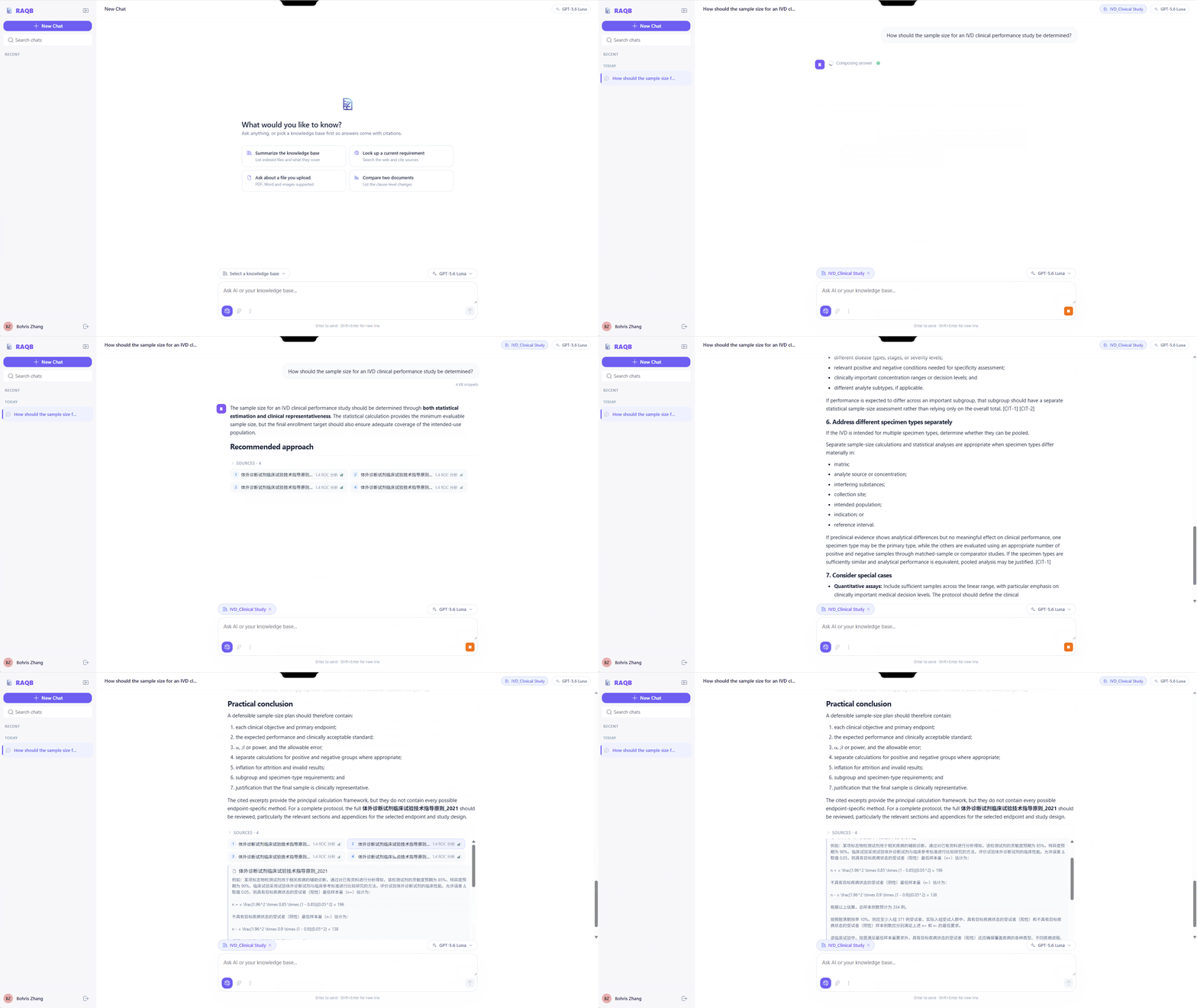
IVD Clinical Studies
and ask:
"How should the sample size for an IVD clinical performance study be determined?"
RAQB first retrieves relevant regulatory and guidance content from the knowledge base and then generates an answer based on those sources, including applicable calculation approaches and formulas where relevant.
More importantly:
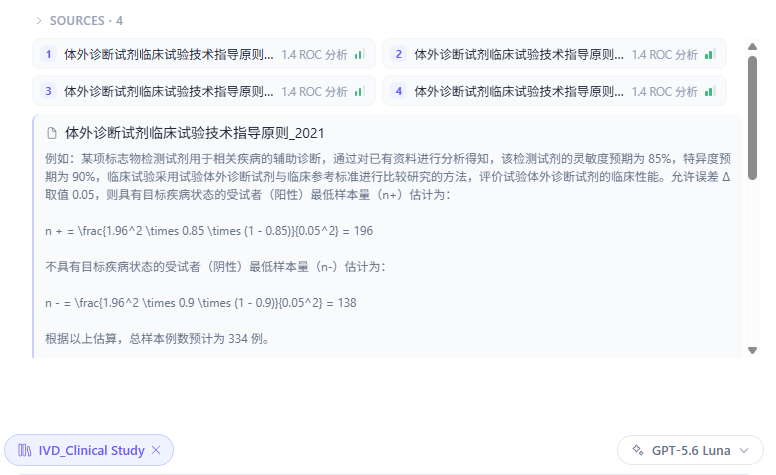
The AI answer is not the end point. The regulatory evidence behind it matters.
The source documents cited by the AI are available with the response, allowing you to trace important conclusions back to the underlying regulatory text.
For Regulatory Affairs professionals, this distinction is critical.
What we need is not simply an AI answer that sounds authoritative. We need an answer that can be traced back to its regulatory source.
Regulatory knowledge bases currently available
| Country / Topic | Knowledge Bases |
|---|---|
| 🇪🇺 European Union (10) | EU MDR EU IVDR EU Medical Device & IVD Classification MDCG – Notified Bodies MDCG – Labelling & Instructions for Use MDCG – Vigilance & Post-Market Surveillance MDCG – Software & Medical Device Software MDCG – Clinical Evaluation MDCG – UDI & EUDAMED MDCG – Transitional Provisions |
| 🇺🇸 United States (10) | FDA 510(k) Pathway FDA Medical Device & IVD Classification FDA Guidance – User Fees & Administrative Policies FDA Guidance – Radiation-Emitting Products & Devices FDA Guidance – Premarket Submission Pathways FDA Guidance – Post-Market Compliance & Quality Systems FDA Guidance – In Vitro Diagnostic Products FDA Guidance – General Device Requirements FDA Guidance – Digital Health & Software FDA Guidance – Clinical Investigations & GCP |
| 🇨🇳 China (5) | China Medical Device Guidance – Non-Active Devices China Medical Device Guidance – Active Devices China Medical Device Guidance – General China IVD Guidance China General IVD Regulations |
| 🇦🇺 Australia (3) | Australia IVD Regulations Australia Medical Device Regulations Australia General Regulatory Framework |
| 🇰🇷 South Korea (3) | South Korea Digital & Software Medical Device Regulations South Korea IVD Regulations South Korea General Medical Device Regulations |
| 🇧🇷 Brazil (3) | Brazil IVD Premarket Regulations Brazil Medical Device Premarket Regulations Brazil General Regulations |
| 🇻🇳 Vietnam (2) | Vietnam Customs & Import/Export Regulations Vietnam Medical Device Regulation & Management |
| 🇦🇷 Argentina (2) | Argentina Premarket Regulations Argentina Post-Market Regulations |
| 🇮🇳 India (2) | India IVD Regulations India Medical Device Regulations |
| 🇦🇪 United Arab Emirates (1) | UAE Medical Device Regulatory Framework |
| 💻 Medical Device Software (1) | Software as a Medical Device (SaMD) Regulatory Collection |
| 🧪 IVD Clinical (1) | IVD Clinical Studies |
| 🌐 International Quality Systems (1) | Medical Device Single Audit Program (MDSAP) |
| 📘 RAQB (1) | RAQB User Guide |
And this is only the beginning
These 45 knowledge bases are the first stage.
RAQB will continue expanding its coverage to additional countries and regions while updating and enriching existing regulatory knowledge bases.
Our goal is not to build another regulatory document repository.
We want to build something different:
A global medical device regulatory knowledge base designed specifically for AI retrieval, interpretation, and source-grounded answers.
The next time you need to investigate an unfamiliar market, you may not need to spend hours searching authority websites, downloading PDFs, organizing documents, and preparing them for AI analysis.
Instead, open RAQB, select the relevant country's regulatory knowledge base, and start your regulatory research.
Stop maintaining the shelf
Every regulatory team is running a small, badly-funded library operation on the side of their actual job. Downloading, filing, wondering if the copy is current, re-downloading, re-cleaning. It produces nothing a notified body will ever see.
We'd rather run that part. You bring the device knowledge and the judgment calls; we keep the shelf stocked, cleaned, and the citations attached.
Browse what's in each knowledge base at raqb.ai/public-knowledge, or go straight to raqb.ai/chat, pick a jurisdiction from the selector, and put a clause-level question to the market you actually work in.
Tell us which jurisdiction or topic you need next. We're publishing on a rolling basis, and which ones land first is genuinely shaped by what people ask for.
New here? Sign in with Microsoft and get 500 points free — enough to try the public knowledge bases straight away. Buying a credit pack later? Use invite code K68N8HEC at checkout for a discount.